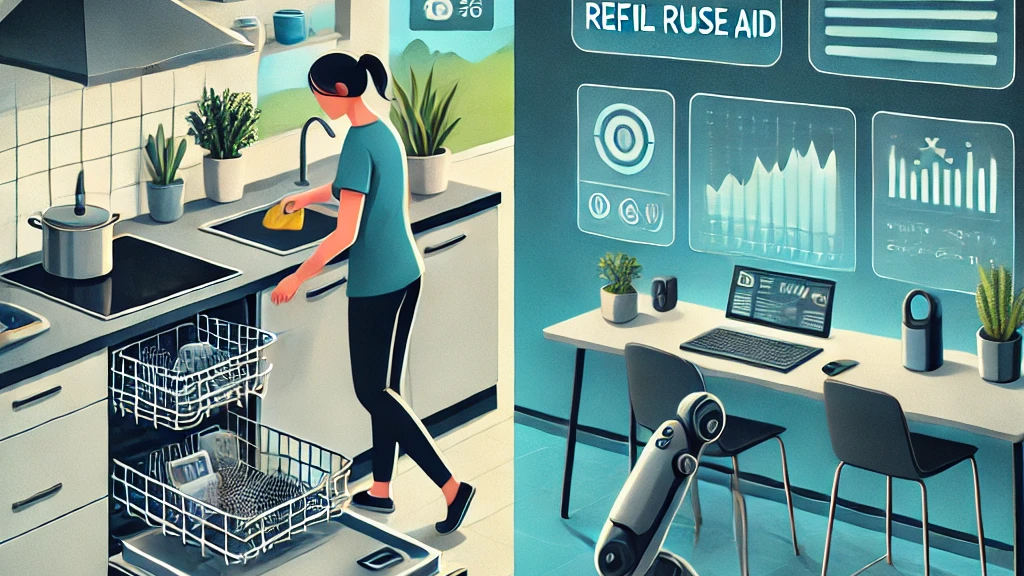
Dishwashers, Robot Vacuums, and AI
As our dishwasher broke down with very interesting but totally unhelpful error messages, I had to do the dishes by hand. Normally when out camping I don’t mind, but at home it felt old-school. As my hands were busy (and wrinkling) my mind started thinking.
Switching from washing dishes by hand to using a dishwasher doesn’t mean the chore disappears. The task just transforms. Suddenly, it’s not about getting the dishes clean. It turns into this entirely other “thing”.
Loading racks the “right” way, wine glasses go there, cutlery goes here. I have to add soap, keep the filter clean, apparently I’m the only who does that? Refill salt, and occasionally troubleshoot mystery messages and leaks. E-1 to E14 you can fix yourself but E-15 and E-16 needs a mechanic.
Yes we still have a Henry, no I am not a shareholder, this thing rocks!
Same goes for robot vacuums. Instead of plugging Henry in and moving it around, I’m charging a little droid, mapped my house. I’m rescuing it from cords or the other way around. I need to empty its bin, and fix the sensors when it starts acting confused.
That’s the hidden truth of automation
The task changes, it does not go away. And this is exactly how AI works in reality. It’s not “fire and forget it.” It’s design, setup, training, alignment, maintenance, review, updates, retraining, and governance. We just discovered a whole continuum of new habits and workflows. Yes I used Continuum so I can plug some songs I like.
Just like a dishwasher doesn’t eliminate my role in keeping the kitchen clean, an AI system doesn’t remove human responsibility. It just reshapes it. Sometimes for the better, sometimes into a different kind of mess. Who knew that there is so little space to manuevre behind the kitchen cabinets to get the old dishwasher out?
When you have a dishwasher, you don’t stop doing dishes. You just start doing different things. You need to load it correctly (or face the wrath of dad). And occasionally, you’re on your knees scrubbing out the filter or decoding that error message that no one understands.
The robot vacuum promises freedom, but it needs regular emptying, firmware updates, and someone to rescue it when it eats a sock, or worse.
You trade one type of labor for another
Building or buying an AI model doesn’t eliminate the work, it reframes it. You still need to do work. Like prepare data, fine-tune parameters, validate outputs and monitor performance. Most importantly you need to align it with your actual business needs. It requires cross-functional alignment, clarity of purpose, and most of all ownership.
Automation shifts the burden, not removes it.
If you’re not prepared for the new type of work that comes with it, your AI investment might end up stuck under the metaphorical couch, spinning in circles.
That’s why the upfront investment: the planning, the alignment, the clarity of value exchange is so critical.
Without it, you’re just introducing a new system that creates invisible work.
I still think that my kids believe that we have leprechauns in our house that do all the washing and the cleaning and the shopping. They just open a cupboard or a cabinet and it’s filled with cups, plates, food, clean clothers etc.


Leave a Reply