Blockchain could solve Data Integrity problems
As the world relies more heavily on data as the basis for critical decision-making, it is vital that this data can be tru

Strategic Technology Leader | Customers Virtual CTO | Salesforce Expert | Helping Businesses Drive Digital Transformation
Blockchain could solve Data Integrity problems
As the world relies more heavily on data as the basis for critical decision-making, it is vital that this data can be tru
All this availability of data connection makes me feel nostalgic
When I first started my journey online I was still on dial-up. Once every while, I listened to the whi
Amazon disrupts again
Amazon is now testing a store in Seattle where customers can walk in, take food off of the shelves and leave, without the hassle of having to wait
ChatGPT or AI in your work environment?
ChatGPT, an A.I. system developed by OpenAI, is available to the public since the end of 2022. It has been making big waves sinc
AI is coming for your job!
There were some awesome news articles about AI and the new stuff they could do: Devin a generative AI powered coding engineer from Cognition
Herding Cats, Seeding Clouds
Yesterdays post by Bard Papegaaij talked about the often used statement “Culture eats Change for breakfast”. And that got me thinking about
AI Agents: Microservices with God Complexes
I have been reading a lot of all the AI innovations that the new Agentic AI promises. Not just watching Muppet show episodes
Our systems are only stable on weekends. And we call that innovation?
Ever notice the silence of a Saturday? No urgent Slack pings. No panicked emails about a failed d
AI of course, still in love with nano banana
Balancing Act: Robustness with Customer Focus
Martijn Veldkamp
“Strategic Technology Leader | Customer’s Virtual CTO | Salesforce Expert | Helping Businesses Drive Digital Transformation”
December 5, 2025
In large-scale enterprise IT, there is a constant, almost gravitational tension between two opposing forces.
On one side, you have the market. It demands speed and radical customer focus. It wants new features deployed yesterday. On the other side, you have Governance. It demands stability, compliance, and zero-risk operations. For years, the industry buzzword was “Agility.” The narrative was that if we just adopted enough scrum teams and microservices, the tension would vanish. But in regulated sectors treating every system as a “move fast and break things” playground isn’t happening.
Strategic architecture isn’t about choosing between speed and stability. It is about architecting a landscape where both can exist in harmony. The biggest thing I see in transformation roadmaps is the attempt to apply a single methodology to the entire IT landscape.
If you treat your core transaction systems like a marketing app, you introduce unacceptable risk. Conversely, if you treat your customer-facing channels with the heaviness of a SAP4Hana migration, you will be disrupted by a startup before you finish your requirements document.
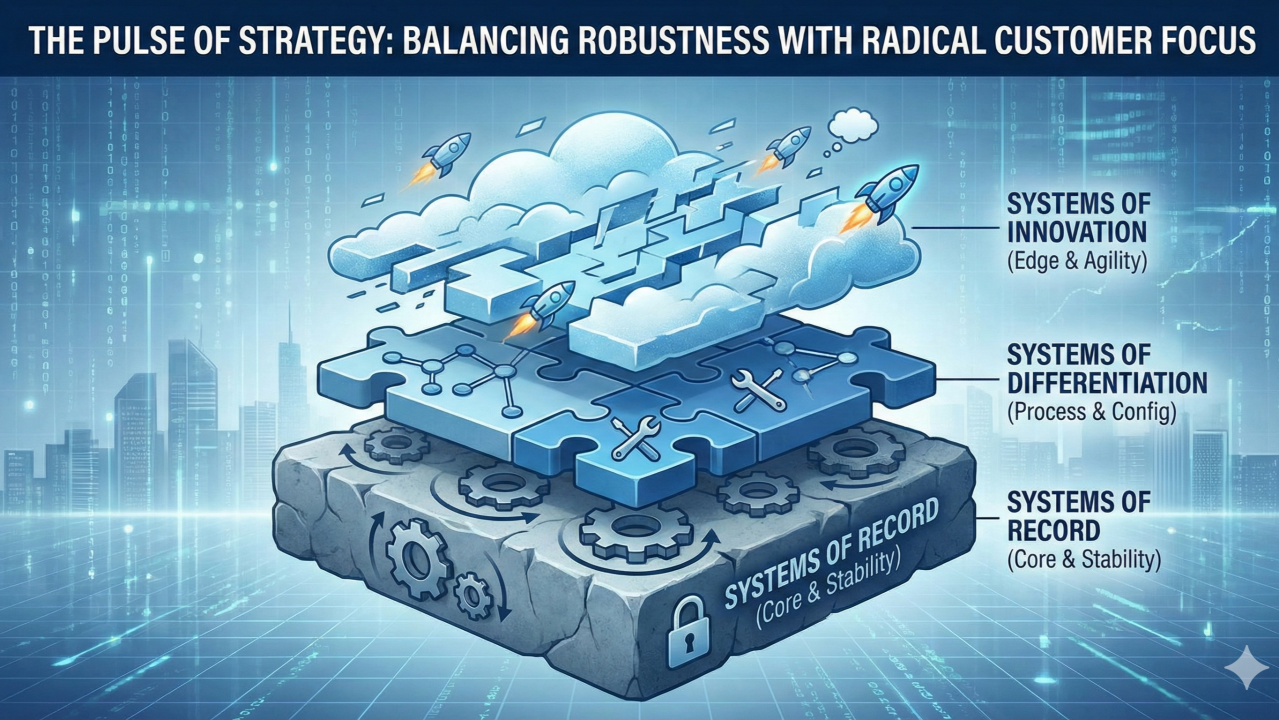
To simplify and modernize a complex application landscape, we have to recognize that different distinct layers breathe at different rates. Speed layering.
Systems of Record, where change is slow, deliberate, and expensive (by design). We want friction here because the cost of error is too high.Systems of Differentiation, where unique business processes live. It connects the core to the customer. We need flexibility here to configure new products, but we still need structure.Systems of Innovation, where we test new customer journeys. If an idea here fails, it should fail fast and cheap without shaking the foundation.
The Architect role shifts from being the “standards police” to becoming city planners. We don’t just draw diagrams, we define zones. We tell the organization: “Here, in the innovation zone, you can use the newest tech and deploy daily. But here, in the core, we measure twice and cut once.”
Implementing this strategy is rarely a technology problem, its a people challenge. It requires coaching stakeholders to understand that “slow” isn’t a dirty word, it’s a synonym for “reliable.” It requires mentoring solution architects to recognize which layer they are building in and to choose their tools accordingly.
When we get this right, we stop fighting the tension between Innovation and Stability. Instead, we use the solid foundation of the core to launch the rapid experiments of the future. We achieve a landscape that is calm at the center, but agile at the edge.
That is how you build an IT strategy that survives the long term.
Having fun with Banano Nano
Stop waiting for “Perfect Data”!
Martijn Veldkamp
“Strategic Technology Leader | Customer’s Virtual CTO | Salesforce Expert | Helping Businesses Drive Digital Transformation”
November 21, 2025
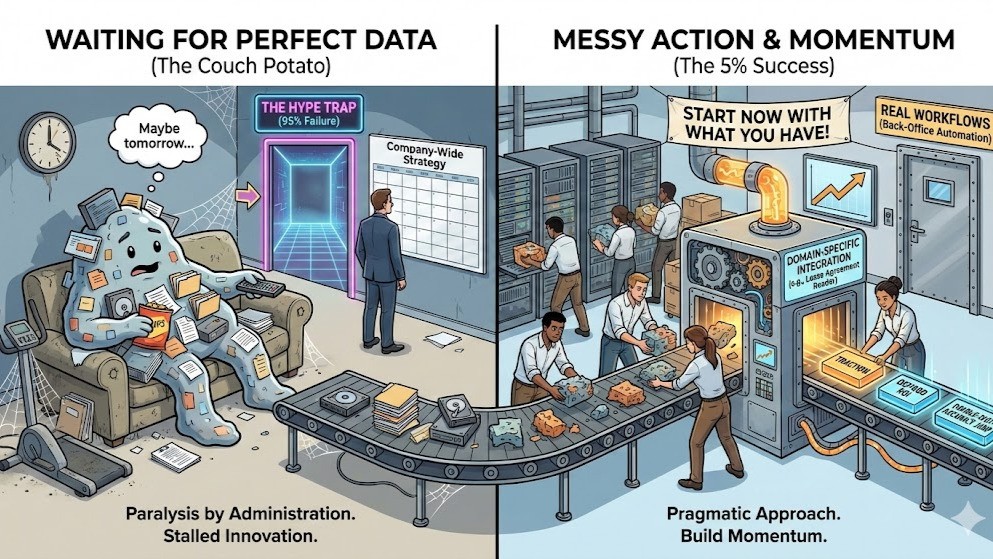
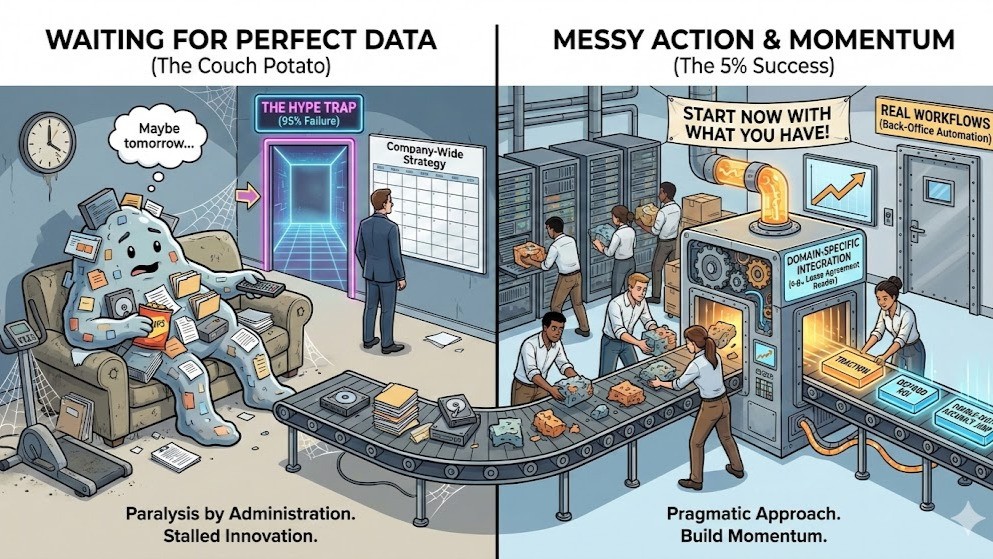
It’s never getting off the couch! The single greatest killer of innovation is not bad preparation but poor administration. Innovation projects are uniquely vulnerable to this because they are not simple IT upgrades, they are fundamental changes to business processes.
The Hype Trap: The 95% of failures are often “hype experiments.” They start with a some flashy tool (like a generic AI chatbot) and go in search of a problem. Rather than the other way around. They stall because they have no clear owner, no defined ROI, and no integration into the actual workflows where you know, actual people do their jobs.The 5% Success: The 5% that get traction ignore the marketing hype. They are the unglamorous, high-return areas like back-office automation. They succeed because they are domain-specific (e.g., an AI that only reads lease agreements) and deeply integrated into a specific workflow.
Just do it!
There’s a common belief that AI initiatives require perfectly clean, structured and in-shape data before you can even begin. This is a form of procrastination. Let’s start tomorrow! Data is the ultimate couch potato, it will never get in shape on its own.
Waiting for Perfect: Companies that wait for a perfect, company-wide data strategy will be waiting forever. As one report on why AI projects fail notes, Garbage in, Garbage out is still a primary obstacle, leading to projects getting stuck in endless data-wrangling phases.The Start Now approach: Successful teams, adopt a pragmatic approach. They don’t wait. One manufacturing project, for example, saw a double-digit accuracy jump not from a better model, but by simply constraining the first version to SKUs that had at least 18 months of (imperfect) historical data. They started with the data they had, proving value, and built momentum from there.
Innovation fails not from bad prep, but from hype and hesitation. Start with a real workflow, use the messy data you already have, and build momentum. The unsexy projects are the ones that will actually drive benefits.