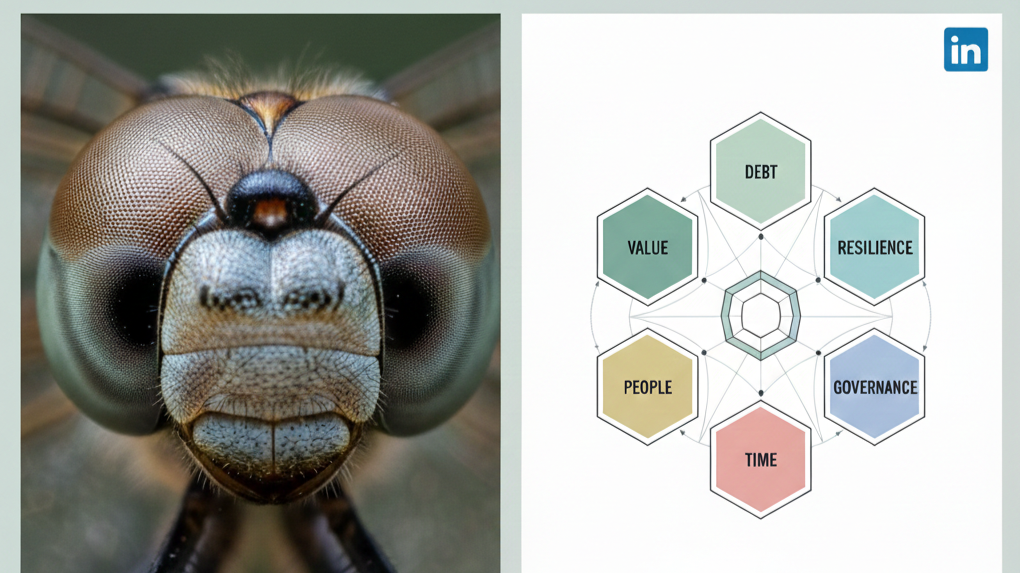
# Why Single-Lens thinking is harming your Architecture Decisions
During summer when the mosquitos were swarming around our farm, a dragonfly hovered right in front of me. Just hung there, mid-air, perfectly still. My dogs didn’t notice. I couldn’t stop staring. There’s something almost alien about how a dragonfly moves. It can fly in six directions, change course in milliseconds, and snatch prey out of the air at speeds that would embarrass most predators. My inner nerd kicked in and I started reading. Unfortunately you cannot buy breeding kits like you can for butterflies. You need to create conditions in your garden so it comes to you, but that will be another topic for another time.
Anyway, as it turns out, a dragonfly has roughly 30,000 individual lenses in its compound eyes. Not one lens that swivels around. Thirty thousand, each capturing a slightly different angle, composited into near-360-degree vision. It doesn’t switch between perspectives. It sees through all of them simultaneously. The result is a 95% kill rate. The most efficient hunter in the animal kingdom. Not just because it’s the fastest or the strongest, but because it sees more angles than its prey can imagine.
I cannot help it, but that is how my brain works. While reading and watching documentaries on Dragonflies I thought about how most organisations do architecture review. ### Most Architecture Review Board have Monocular Vision
Let’s be honest. Most enterprise architecture decisions are made through a single lens. The lens depends on whoever is loudest in the room. Like most board meetings. The business sponsor sees Value: “Does this feature get us revenue by Q3?” The finance controller sees Cost: “What’s the TCO over five years?” The security officer sees Risk: “What’s the attack surface?” The delivery lead sees Speed: “Can we ship before the competition?”
Each of these is a legitimate perspective. The problem is that we treat them as competing arguments in a debate, and whoever argues most convincingly wins. One lens beats the others. The decision gets made. We move on. And then, eighteen months later, when the thing we built turns out to be a maintenance nightmare that nobody on the team understands well enough to evolve, we act surprised. We shouldn’t be. We made a decision with monocular vision. We could see distance but not depth. We could see forward but not sideways.
A dragonfly would never make that mistake. _(Yes, I just compared an architecture review board unfavourably to an insect. Stay with me.)_ ### Compound Eyes for Complex Decisions
In my earlier articles, I’ve circled around this problem from different directions. I wrote about how gravitational lensing distorts our perception of organizational challenges, how context fossilizes into an Amber Trap, and how our systems are only stable on weekends, because we optimise for the wrong things. These are all symptoms of the same cause: single-lens decision-making.
So what would compound-eye thinking look like for architecture decisions? I’ve been chewing on this, and I think there are six lenses that matter. Not as a framework to memorise and put on a slide _(please, we have enough of those)_, but as a habit. A way of forcing yourself to see what you’re naturally blind to. I’m still exploring this bit, so this will grow and mature over time. –
**Value:** What problem does this actually solve? For whom? Is the value real or are we just automating bureaucratic theatre? –
**Debt**: What future liability does this create? Every line of code is a future maintenance obligation. Every new integration is a dependency you’re borrowing against. I wrote about this in Escaping the Feature Factory. LEGACY doesn’t care about your framework –
**People**: Can the team build, own, and maintain this? Not just today, but in two years when the original developers have moved on? For most implementations it’s terrifyingly low. –
**Time:** How does this decision look at six months versus three years versus a decade? Some choices feel right today and still fossilise into traps. –
**Resilience**: What happens when this fails? When the vendor pivots? When the world changes? Not “if” but “when”. If you’ve ever lived through an Amazon outage you know what I mean. –
**Governance**: Can we control, audit, and explain this? Who’s accountable when an autonomous agent makes a decision nobody can trace?
Six lenses. Not six boxes to tick. Six directions to look before you commit. ### Rotate, don’t debate
Because the beauty is in the tension. Here’s what I’ve experienced: the best architecture decisions don’t come from picking the right lens. They come from identifying the _tension between lenses_ and making that tension explicit.
Value versus Debt. Speed versus Resilience. Innovation versus Governance. These aren’t bugs in your decision process. They’re features. When two lenses conflict, that’s where the interesting conversation lives. That’s where the actual trade-off becomes visible instead of hiding behind assumptions.
A single-lens decision feels clean and fast. A compound-eye decision feels uncomfortable, maybe even slow. But one of them has a 95% success rate and the other one keeps getting eaten.
I want to be clear: I’m not suggesting you cram six perspectives into every meeting and every document. That way lies the Poolse Landdag. The point is to be _conscious_ about which lenses you’re using and which ones you’re ignoring. If you made a decision through the Value and Speed lenses, at least acknowledge that you haven’t looked through the People and Resilience lenses. Write it down. Own the blind spots.
Most solid decisions activate two or three lenses. The really good ones, the ones that survive contact with reality, surface a tension between lenses and resolve it honestly. And once in a while, you get a compound-eye decision that makes the reader of your architecture document think: “I hadn’t considered that angle.” Those are the ones people forward to colleagues.
**What to do differently tomorrow:** Take your next architecture decision, the one already on your desk, and run it through three lenses you haven’t considered yet. Write down what each lens reveals. If two lenses conflict, don’t resolve it in your head. Put the tension on the table. That’s where the real conversation starts.
_Listening to while writing: Converge – Jane Doe. Because sometimes you need 30,000 lenses worth of sonic aggression to see clearly. Also they have a new record out Love Is Not Enough._
Leave a Reply