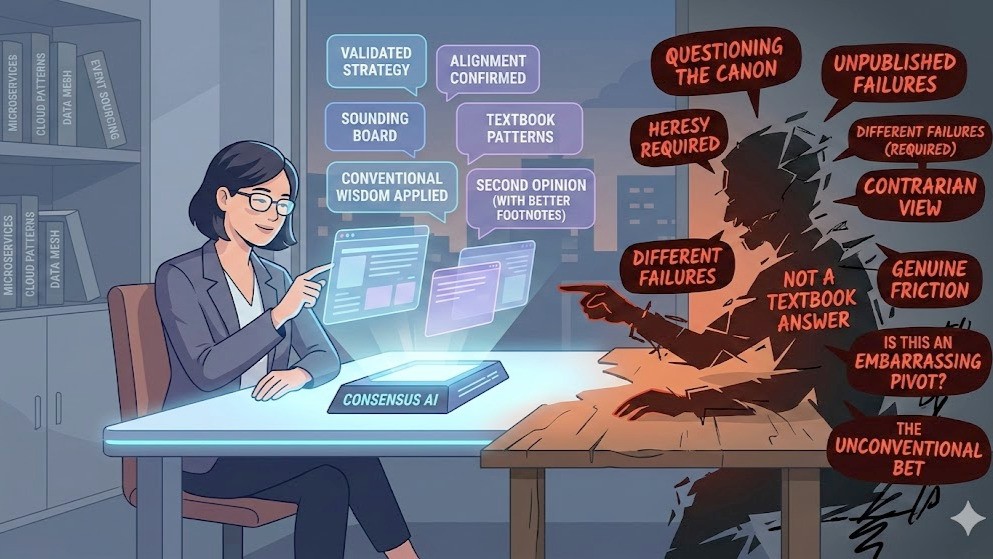
You asked ChatGPT whether your strategy made sense. It gave you five well-reasoned paragraphs explaining why it did. You felt better.
That feeling is the problem.
We have quietly started using AI as a sounding board for big decisions. Architecture choices, technology bets, platform strategies, build-vs-buy calls. We share our thinking, ask the model to stress-test it, and wait for the push back. When it comes back measured and thoughtful and mostly agrees with us, we feel validated. We tell ourselves we sought a second opinion.
We did not.
Here is what I think that actually happened. You gave your thinking to a system trained on every technology blog post, conference talk, architecture decision record, vendor whitepaper, and thought-leadership piece ever published publicly. It knows the canon. It knows the orthodoxies. It knows what the consensus says about micro services, cloud patterns, data mesh, event sourcing, and feature factories. It has read, in aggregate, everything the industry has decided is conventional wisdom.
When you ask it to challenge your strategy, it challenges it using that same conventional wisdom. It might poke at the edges, suggest considerations you missed, ask about scalability at the margins. But what a good strategy looks like, what the industry expects, what the established patterns say. That industry frame is baked in. You are not getting an independent perspective. You are getting a very articulate summary of the current consensus applied to your specific problem.
That is not a second opinion. That is the same opinion with better footnotes.
All the textbooks, none of the heresy
When you seek a genuine second medical opinion, you look for a doctor who trained differently, has seen different patient populations, works from different clinical experience. You are not looking for a doctor who read the same textbooks as your first one and happens to have a slightly different bedside manner.
An AI model is a doctor who read all the textbooks. Every single one. Every paper, every case study, every published diagnosis. Which makes it very good at pattern-matching against established medicine. And very limited at telling you something is wrong with the textbooks themselves.
The model was not trained on the strategic pivots that never made it to conference talks because they were embarrassing. It was not trained on the things the industry quietly stopped believing in but never publicly retracted. It was not trained on the paths not taken, the bets that looked stupid at the time and turned out right, the decisions that made sense only through a contrarian lens.
Simon Wardley (you know, he of the maps that actually make sense, and the BLA acronym) has a useful observation here. Mmost published material discusses things that are already moving toward commodity. The emerging, the genuinely novel, the still-being-figured-out. Those things do not have a developed body of published wisdom yet. Which means the model is disproportionately good at evaluating commodity decisions and much worse at evaluating the decisions where independent thinking actually matters. The further your bet sits from the established consensus, the less useful the model’s challenge will be.
Checking the box that doesn’t check anything
This would be an inconvenience if it stayed at the level of architecture patterns. The real risk is at the strategic layer.
A CTO using AI to challenge a three-year technology investment thesis has, without realizing it, introduced a governance step that looks like challenge but produces consensus. The output goes into the decision package. The strategy was stress-tested by AI. Leadership feels better. The decision moves forward.
I’ve written before about Fire and Forget (the illusion that automation completes the work when it just shifts where the work happens). This is the governance version of that. The AI challenge step completes the process without doing the actual work of the process. The work of a genuine second opinion is the independent formation of a view. That is precisely what the model cannot do, its views were formed long before you ever opened the prompt.
The more consequential the decision, the more this matters. Stress-testing an API design choice with an AI in Postman? Perfectly reasonable. Stress-testing the assumption that your organization should be betting on a particular technology platform for the next five years? You need someone whose priors were shaped by different failures than yours.
What independent challenge actually requires
Genuine pushback on strategy requires someone who was not formed on the same inputs you were. Which usually means:
Someone who came up in a different industry and is applying those instincts here Someone whose incentives are misaligned with yours (not a consultant whose engagement depends on the project proceeding) Someone who has been wrong in a way you have not been wrong yet Someone who thinks your current direction is overhyped (especially useful if you are using AI to challenge your AI strategy)
This is not a comfortable list. These conversations are harder than asking a model. They take longer. The challenge is less organized, sometimes confusing. That is the point. If the challenge is comfortable, it is probably not challenging anything that matters. You need the actual friction of different experiences and opinions.
The question is not whether AI can help you think. It clearly can. The question is whether you know the difference between thinking more clearly about the consensus and questioning the consensus itself. One of those an AI is very good at.
What to do differently tomorrow: The next time you use AI to challenge a strategic decision, ask yourself/; is this the conventional part of the bet or the unconventional part? If it is conventional, AI feedback is useful noise filtration. If it is the part of your strategy that breaks from industry consensus, the model can only evaluate it against the consensus it was trained on. Find a human for that conversation.
Leave a Reply