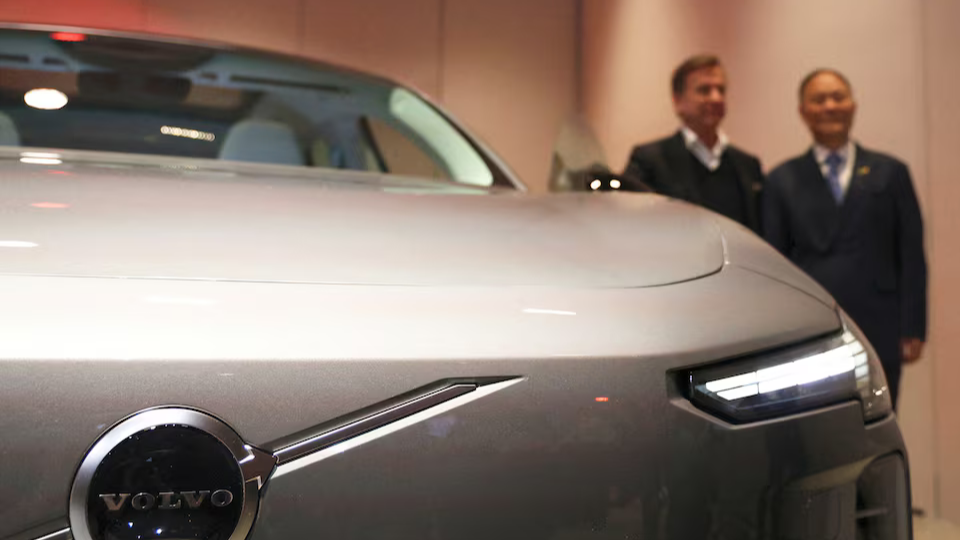
A few weeks ago I mentioned that one of our chickens has decided the old red Volvo is her spot. She sits on the bonnet in the morning like she paid for it. The car now permanently smells faintly of horse and slightly of chicken, which I am told is not a Volvo option package.
Anyway. I was standing there shooing her off and I thought about who actually owns that badge, and then I went and looked up the timeline, and the timeline is not the story I had in my head. I suspect it is not the one in your head either.
The story I told myself went a bit like this. Geely started out making cheap parts, got very good at manufacturing, ground the cost curve down like the way I described with lighters and solar panels last week, and eventually earned enough money and credibility to buy a premium European brand. Manufacturing excellence, patiently converted into a badge. It is a nice story and it has a moral in it (work hard, earn the badge, everybody claps).
2010 apparently, not 2020
Geely made refrigerator parts in 1986, motorcycles in 1994, and cars from 1997. And then in 2010 they bought Volvo Cars from Ford for around USD 1.8 billion, announced somewhere in March that year and closed in August.
The platform came after that. Their CMA, the modular architecture co-developed by Geely and Volvo, showed up in 2016 and debuted on the Volvo XC40 a year later. That same platform then went on to carry the Lynk & Co 01, 02, 03 and 05, the Polestar 2 and the electric XC40. Volvo alone has sold over 600,000 cars on it. Lotus followed in 2017, then SEA (the EV architecture) in 2020, then Zeekr in 2021.
So the sequence runs brand, then platform, then everything else. Which is the opposite of how I had it in my head. The academic write-ups of the deal are unusually blunt about what it was for. Joint R&D ventures, a shared engine plant, integrated supply systems, coordinated procurement, and a jointly developed platform. All of it aimed at upgrading Geely’s own process and product capability. They did not buy a badge and hope. They bought an engineering organisation and spent 15 years running a transfer program through it.
Stan Shih at Acer drew this in 1992 I believe, and called it the smiling curve. Put the value chain on the horizontal and margin on the vertical, and you get a smile. Components and R&D are high on the left, brand and service are high on the right, and assembly sits in the trough in the middle where everybody competes on cents. Every one of the examples I have been chewing on for the last months is a firm trying to climb out of that trough.
And what I think Geely worked out, earlier than most, is that you do not climb. You buy the far end of the curve and then build the middle underneath it.
Still a good point, but…
I wrote a piece at the end of July about buying a logo and not the understanding, and my main argument was that acquirers price what they can see and never price the comprehension that is about to resign. I still think that is right, I have watched it happen twice.
However, Geely is the counter-case, and it took me a while to admit that, because it undercuts the nice and easy version of my own argument.
They did get the system, and not by being clever in the data room. They got it because somebody planned a decade-long transfer before the ink was dry. And then actually staffed it. And then let Volvo keep operating as Volvo while the transfer happened. The engineers stayed, the plants got built jointly, and the platform was co-developed rather than dictated.
I should be careful here, because that could be read more than the facts that I can dig up support and I do not want to sell you a far fetched fairy tale. Polestar has been losing money for years. And in 2024 Geely folded Lynk & Co into Zeekr and rebranded the lot as Zeekr Group, which is a consolidation, not a victory lap. And so they ended up with a portfolio they then had to prune, same as everybody else.
But what they were pruning? Brands, not capability. The platforms underneath survived every reshuffle, and that is my whole point. My opinion is that the transfer worked and the brand strategy on top of it was a Poolse landdag (very typical Dutch word).
I also wrote earlier this summer about the muscle you decide not to build, the capability you quietly trade away on that beautiful build-versus-buy slide. Put the two together and you get something uncomfortable. Geely did not need to invent premium safety engineering and a brand people trust with their kids. It needed to identify who already had it, and be willing to wait 15 years to absorb it.
So if you are on the buying side, the question is not what does this acquisition give us access to. Access is easy, access is a contract (and a contract is a thing somebody can change). The question is who is running the transfer, for how many years, and whether that person is real or just a line in the integration deck that quietly disappears after the second quarter. If nobody on your side can name them, you are not buying a capability. You are renting one, and you are paying an acquisition price for a rental!
Where this goes next is the part I did not see coming when I started. The whole Geely move depends on being able to buy the top of the curve. You need somebody to be willing to sell it to you.
Which is a problem, because in the thing I actually want to talk about, nobody is selling. But that is for next week.
Swedish thing to leave you with, since we are on Volvo. Go and listen to Refused, The Shape of Punk to Come. 1998, and still ahead of most of what came after it. The chicken is back on the bonnet as I type this, she does not care about any of it, she’s out of the rain.
Leave a Reply